
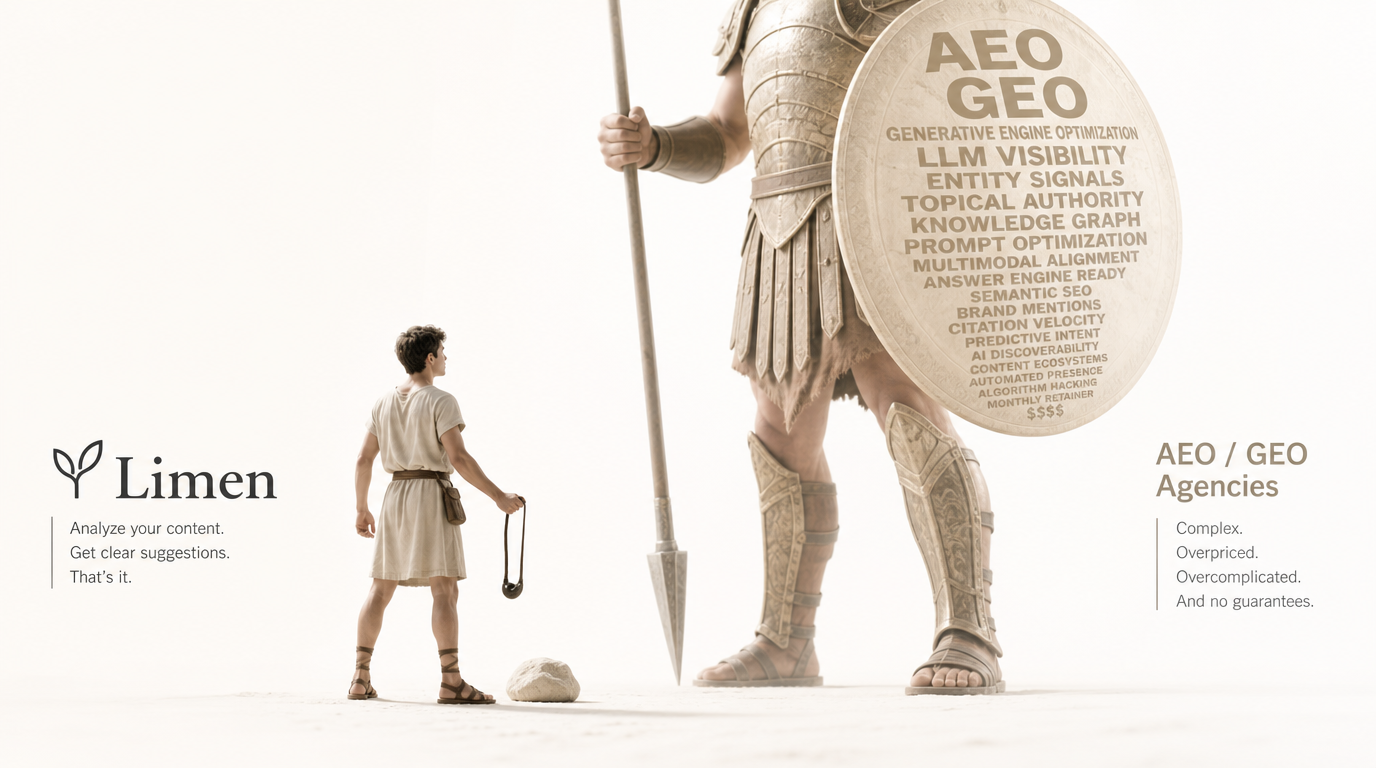
One evening you type an honest question into a search bar: how do I show up in ChatGPT? Ten minutes later you know a few new acronyms (AEOAnswer Engine Optimization (AEO): Answer Engine Optimization (AEO) is the practice of structuring your content so an AI or search engine can lift a clear, direct answer from it and show it to the person asking. Read the full entry in the glossary.Answer Engine Optimization (AEO)Answer Engine Optimization (AEO) is the practice of structuring your content so an AI or search engine can lift a clear, direct answer from it and show it to the person asking.Read full entry, GEOGenerative Engine Optimization (GEO): Generative Engine Optimization (GEO) is the practice of shaping your content so AI tools like ChatGPT, Perplexity, and Google's AI answers cite, quote, or recommend your business when they respond. Read the full entry in the glossary.Generative Engine Optimization (GEO)Generative Engine Optimization (GEO) is the practice of shaping your content so AI tools like ChatGPT, Perplexity, and Google's AI answers cite, quote, or recommend your business when they respond.Read full entry, LLMOLarge Language Model Optimization (LLMO): The practice of making your website legible and quotable to large language models — the third name for the work already called AEO and GEO, and much the same discipline. Read the full entry in the glossary.Large Language Model Optimization (LLMO)The practice of making your website legible and quotable to large language models — the third name for the work already called AEO and GEO, and much the same discipline.Read full entry) and you've picked up a new feeling in your stomach. Every result seems to be a platform for "brands." You scroll past a dashboard demo, then a whitepaper hidden behind a contact form, and every pricing page ends with an invitation to talk to sales. Nobody prints a price. The message underneath it all is hard to miss: this world was built for companies with a marketing team, and you don't have one.
So you close the laptop and decide this is out of your league. Take a second look at that decision, though, because the entire industry depends on you making it. Somebody profits every time a small business owner concludes that being visible has become too expensive to attempt.
The fear industry
Complexity sells. When AI visibilityAI Visibility: AI visibility is how often, and how accurately, AI assistants name your business when someone asks them a question you could have answered. Read the full entry in the glossary.AI VisibilityAI visibility is how often, and how accurately, AI assistants name your business when someone asks them a question you could have answered.Read full entry looks like rocket science, full of entity graphsEntity: A specific thing a machine can recognise and hold facts about — your business as a distinct identity, rather than a string of words that happens to appear on a page. Read the full entry in the glossary.EntityA specific thing a machine can recognise and hold facts about — your business as a distinct identity, rather than a string of words that happens to appear on a page.Read full entry and prompt-share matrices, hiring a specialist feels like the only responsible move, and specialists in this field bill retainers that run to four and five figures a month. The vocabulary does a lot of the selling. A confused customer rarely negotiates.
Read those sites again and pay attention to who they address. Enterprise brands. Agencies and their client rosters. You won't find a sentence written for the owner of a physiotherapy practice with one decent website and no marketing department, which is odd, since small businesses stand to lose the most when AI assistants stop mentioning them. The people who most need this explained are the ones the industry never bothered to write for.
Underneath all that vocabulary sits something disarmingly ordinary: a website. Yours, in fact. You already own it and you can already edit it, and the whole discipline comes down to whether a machine can make sense of what's written on it. There is no secret machine room behind the curtain. There are your pages, and there is the question of whether a machine can read them.
The myth of monitoring everything
The most profitable part of the packaging is the monitoring myth. It says you have to track your brand across ChatGPT, Claude, Gemini, Perplexity and whichever engine launched while you were reading this sentence, because otherwise you're flying blind.
To be fair, monitoring exists for a reason. A global brand with an advertising budget and a communications team gets real value from knowing how often each model mentions it. For everyone else the flaw is practical: a monitoring dashboard behaves like a scoreboard, and no scoreboard ever moved a ball. You could watch yourself go unmentioned in five parallel dashboards, in real time, for years.
The vendors also skip a detail that carries this whole article: every one of those enginesAnswer Engine: A tool that responds to a question with a direct answer instead of a list of links to click — like ChatGPT, Perplexity, or the AI summaries now sitting at the top of Google. Read the full entry in the glossary.Answer EngineA tool that responds to a question with a direct answer instead of a list of links to click — like ChatGPT, Perplexity, or the AI summaries now sitting at the top of Google.Read full entry reads the same source, namely your website. Fix the source once and your standing improves with all of them at the same time, including engines that haven't launched yet. One toolbox beats five scoreboards.
A dashboard can tell you the machines ignore you. It cannot make them stop.
What actually matters
Strip the acronyms away and one question remains. When a machine reads your site, does it understand your business well enough to repeat it to a stranger? Every audit and framework on the market circles that single question.
An AI assistant never sees your design or your brand video. It reads your text and your page structureMachine Readability: Whether the meaning of a page survives being read by software — the plainest test of whether an AI can understand what is actually on it. Read the full entry in the glossary.Machine ReadabilityWhether the meaning of a page survives being read by software — the plainest test of whether an AI can understand what is actually on it.Read full entry, then decides within moments whether you're safe to quote. Plenty of good businesses fail that reading. In almost every case the site was simply written for human eyes, back when human eyes were the only readers around.
What Limen does about it
Limen was built for exactly this job, and we kept the process deliberately boring. You paste your web address. We scan the site the way an AI assistant would read it and hand back a list of findings in plain language, each one telling you what's already fine or what needs to change, with the fix written out underneath. There's no kickoff call, and nobody will invite you to a workshop.
Every fix carries a tag that tells you who can do it. ✓ You can do this yourself covers the text changes, which ask for nothing more technical than patience. ↦ We wrote the code — you paste it in arrives with the snippet already written. The third tag, ⚙ Needs a developer, appears rarely and is labelled honestly, so you know the one situation where an hour of hired help earns its money. Most sites collect their points in the first two buckets.
When you've changed something, you re-scan and watch the number respond. The plan includes twenty scans a month, enough to treat fixing and checking as a single afternoon's loop. Your first scan costs nothing. The full dashboard costs $30 a month, or $300 for a year, and cancelling keeps your access until the period you paid for runs out. Around here that kind of money buys a large pizza with extra toppings.
We're stubborn about one detail. The score never flatters you. It comes from a real scan of your real pages, and ticking a checkbox in the dashboard will never nudge it upward. When the number moves, your website changed. Considering how much fog this market produces, we think that plainness deserves a mention.
One number, one line
You won't be chasing a perfect hundred either. The dashboard shows one score out of 100 and marks a small tick at 80. We call that line the limen, after the old word for a threshold, because machine perception flips there from invisible to named. Once you're across, the remaining twenty points amount to polish. The full story of the 80 line, including how the company ended up named after it, lives in another essay in this journal called The 80-point door. For today the short version will do: get above 80 and the machines can see you.
The door isn't locked
The market you met that evening wanted you to feel small, and it wanted the feeling to be expensive to cure. Your website tells a different story. It sits there right now, one honest reading away from being fixable by you personally, this week, for less than the cost of a decent lunch. Nobody needs to sign a retainer for that.
Paste your address and see where you stand. The door was never locked.