
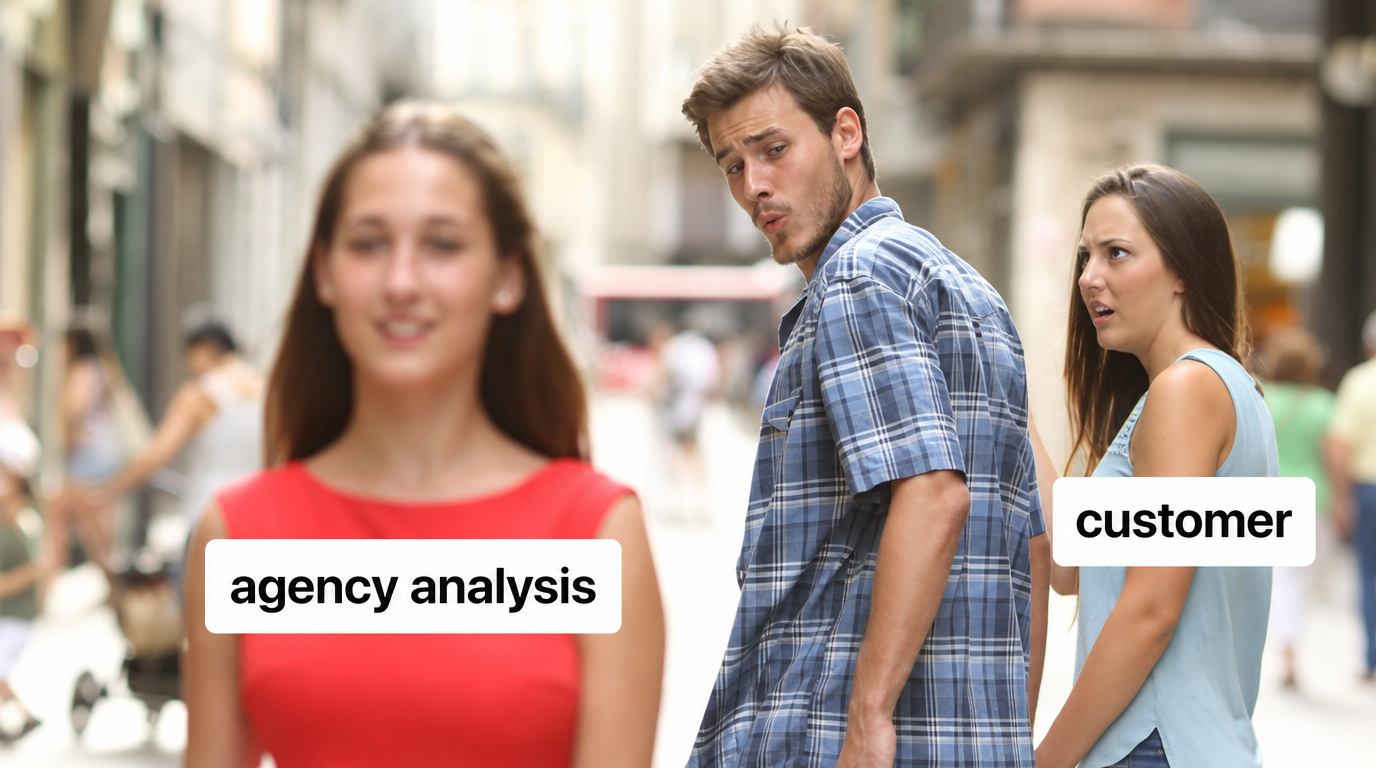
Limen exists because of my own website. One evening I asked an AI assistant the kind of question a potential customer might ask, the kind my site is supposed to be the answer to. The reply was fluent, confident and genuinely helpful. It recommended other people.
I sat with that for a while. My site was not badly built. It loaded fast, it looked fine, and it said things I had worked hard on. But it was not written for the systems people now ask instead of searching, and I caught myself asking the question this whole article is about: what can I actually do to better that?
So I went looking for how the professionals handle it. What I found explains a great deal about why small businesses feel locked out of this subject. It also points at a door that was open the whole time.
How the professional machinery works
For twenty-five years the discipline was called search engine optimizationSearch Engine Optimization (SEO): Search engine optimisation is the work of making a website rank highly in a list of search results — for twenty-five years, the main way a business got found online. Read the full entry in the glossary.Search Engine Optimization (SEO)Search engine optimisation is the work of making a website rank highly in a list of search results — for twenty-five years, the main way a business got found online.Read full entry, and at its center sat a research problem: which words do people type into Google, and which of those words could your website plausibly win? Agencies answered it with tooling. Search volumes, competitor gaps, ranking difficulty, click curves, hundreds of parameters per keywordKeyword: A word or short phrase someone types into a search box — and, for twenty-five years, the unit that search engines and the whole optimisation industry were organised around. Read the full entry in the glossary.KeywordA word or short phrase someone types into a search box — and, for twenty-five years, the unit that search engines and the whole optimisation industry were organised around.Read full entry, refreshed monthly and condensed into a strategy.
Then people started asking assistants instead of typing keywords. Ask ChatGPT to recommend a physiotherapist in your town and it names two or three. There are no ten blue linksTen Blue Links: Ten blue links is the old shape of a search result — a page of clickable headlines handing you a list of possibilities instead of an answer. Read the full entry in the glossary.Ten Blue LinksTen blue links is the old shape of a search result — a page of clickable headlines handing you a list of possibilities instead of an answer.Read full entry, there is an answer. The discipline that chases this is called answer engine optimizationAnswer Engine Optimization (AEO): Answer Engine Optimization (AEO) is the practice of structuring your content so an AI or search engine can lift a clear, direct answer from it and show it to the person asking. Read the full entry in the glossary.Answer Engine Optimization (AEO)Answer Engine Optimization (AEO) is the practice of structuring your content so an AI or search engine can lift a clear, direct answer from it and show it to the person asking.Read full entry, or generative engine optimizationGenerative Engine Optimization (GEO): Generative Engine Optimization (GEO) is the practice of shaping your content so AI tools like ChatGPT, Perplexity, and Google's AI answers cite, quote, or recommend your business when they respond. Read the full entry in the glossary.Generative Engine Optimization (GEO)Generative Engine Optimization (GEO) is the practice of shaping your content so AI tools like ChatGPT, Perplexity, and Google's AI answers cite, quote, or recommend your business when they respond.Read full entry depending on who is selling it, and the research got harder because nobody can see inside the machine.
So the agencies do the only thing you can do from outside: they interrogate it. They run countless prompts against every major assistant, phrased every way a customer might phrase them, and log which businesses get named. They run the same prompts again next week, because answers drift. They test variations by city, by wording, by language. They cross-reference which sources the machines cite and reverse-engineer what those sources have in common. It is real work, it produces real knowledge, and it takes a team: analysts, tooling subscriptions, dashboards, and a retainer that runs to thousands a month, every month.
None of that is a scam. It is simply built for companies that can spend like companies. A bakery cannot. A physiotherapist cannot. A freelance photographer with a portfolio site certainly cannot. And that is the audience this article is for.
The question that actually matters
Strip the industry away and one question remains. If you cannot hire any of this, what can you, one person with a website, do to become more visible to the AI systems your customers are already asking?
The locked-out feeling suggests the answer is nothing. That is the wrong answer. The systems being interrogated by all those dashboards are, in the end, reading websites. When an answer engineAnswer Engine: A tool that responds to a question with a direct answer instead of a list of links to click — like ChatGPT, Perplexity, or the AI summaries now sitting at the top of Google. Read the full entry in the glossary.Answer EngineA tool that responds to a question with a direct answer instead of a list of links to click — like ChatGPT, Perplexity, or the AI summaries now sitting at the top of Google.Read full entry assembles a recommendation, it works from pages it has read and understood. And here the little guy has more room than anyone tells him, because most websites, including expensive ones, fail at being readable in this sense.
Clarity is the strategy
Here is what the machines need from you, reduced to its honest core. They need to find, somewhere on your site, in plain words, what you do, where you do it, whom you do it for, and how to take the next step. And they need your site to answer the questions a real customer would ask, because those are exactly the questions real customers now put to the machines.
Notice what is missing from that list: any research you cannot do. You do not need to analyze hundreds of prompts to learn what people ask a plumber. You hear it on the phone every week. What does it cost, how fast can you come, do you handle old buildings, which neighbourhoods do you cover.
The agencies run their prompt farms to approximate, at scale and at great expense, the knowledge you already hold about your own trade.
You cannot outspend the big players, and you should stop trying to. But you can out-answer them. The site that answers plainly beats the site with the bigger budget far more often than either side expects.
A website whose every page says clearly what it is about, and which answers its customers' ten most common questions in honest paragraphs, has already done more for its AI visibility than a retainer would have bought it. Everything the retainer buys sits on top of exactly this, and none of it can substitute for it.
Where to start, concretely
If you have absolutely no idea where to begin, begin here. None of this needs a developer, and most of it is a matter of writing.
Say what you do in one sentence, near the top of your homepage. Trade, place, audience. "We are a family bakery in Lucerne, and we bake everything the same morning we sell it." If a stranger, human or machine, reads only that sentence, they should already be able to describe your business.
Write down the questions you answer on the phone, then answer them on the site. The price question. The how-long question. The do-you-also question. Each one gets its own honest paragraph, ideally under a heading that states the question the way a customer would say it. This is what answer-shaped contentAnswer-Shaped Content: Writing that leads with the answer to a real question instead of arriving at it — the single change that most often decides whether a machine can quote you. Read the full entry in the glossary.Answer-Shaped ContentWriting that leads with the answer to a real question instead of arriving at it — the single change that most often decides whether a machine can quote you.Read full entry means, and it is nothing more mysterious than that.
Give each thing you offer its own plainly named page or section. One page that mentions seven services in passing is hard to draw an answer from. Seven short sections, each with a plain heading and a few honest sentences, are easy.
Write the way you speak to a customer. The voice you use at the counter is the right voice. Machines are trained on human language, and they cope far better with "we repair bicycles, usually within two days" than with "comprehensive mobility solutions".
Check that your basic facts agree with each other. Name, address, phone number, opening hours: the same everywhere they appear, on your site and off it. Machines cross-check, and disagreement reads as unreliability.
Reread your site as a stranger twice a year. Businesses drift and sites lag behind them. The page that no longer says what you actually do is worse than no page, because it is confidently wrong.
The part where I tell you what I built
I said this began with my own website and the question of what I could do about it. Limen is my answer to that question, so this is the part of the article where I declare an interest and keep it short.
Limen reads your website the way an AI system reads it, page by page, and checks it against the things this article has been describing: whether it is clear what you do, whether the common questions are answered, whether a machine can actually get at your content, and a good deal more. Then it tells you, in plain language, where you stand, what is lacking, and how to fix each thing it found.
For the fixes that are fiddly to write, it goes one step further and writes the AI prompt for you: a precise, ready-made instruction you can paste into ChatGPT or Claude, so the model drafts the repair for your specific page instead of handing you generic advice. You stay the editor. The machine does the typing.
What it will not do is run prompt farms or promise you rankings. It shows you your own website the way the machines see it, which is precisely the piece of agency work the little guy actually needs, at a price that is nowhere near thousands a month. It lives at translimen.io, and the first look at your site is free.
The agencies keep their place
I want to end by being fair to the expensive machinery, because the point of this article is sequencing, and a cheap dismissal would teach you the wrong lesson.
Prompt analysis, citation tracking, competitive monitoring: for a company in a crowded market with the basics long since done, that work is worth paying for. Someone should be watching how the answers drift and what the competition keeps getting cited for. When your website is clear, your questions are answered, and the stakes have grown past what one person can watch, hiring that watchfulness is the logical next investment.
But it is the second storey of the house. The agencies themselves would tell you, quietly, that their cleverest analysis cannot rescue a website that never says what the business does. Clarity first. Fancy later, if ever. And for many small businesses, honestly, the first storey is the whole house.
Start with the sentence that says what you do. Everything else in this field, the acronyms, the dashboards, the retainers, is built on the assumption that it exists. Most sites never write it. Yours can, this week.