
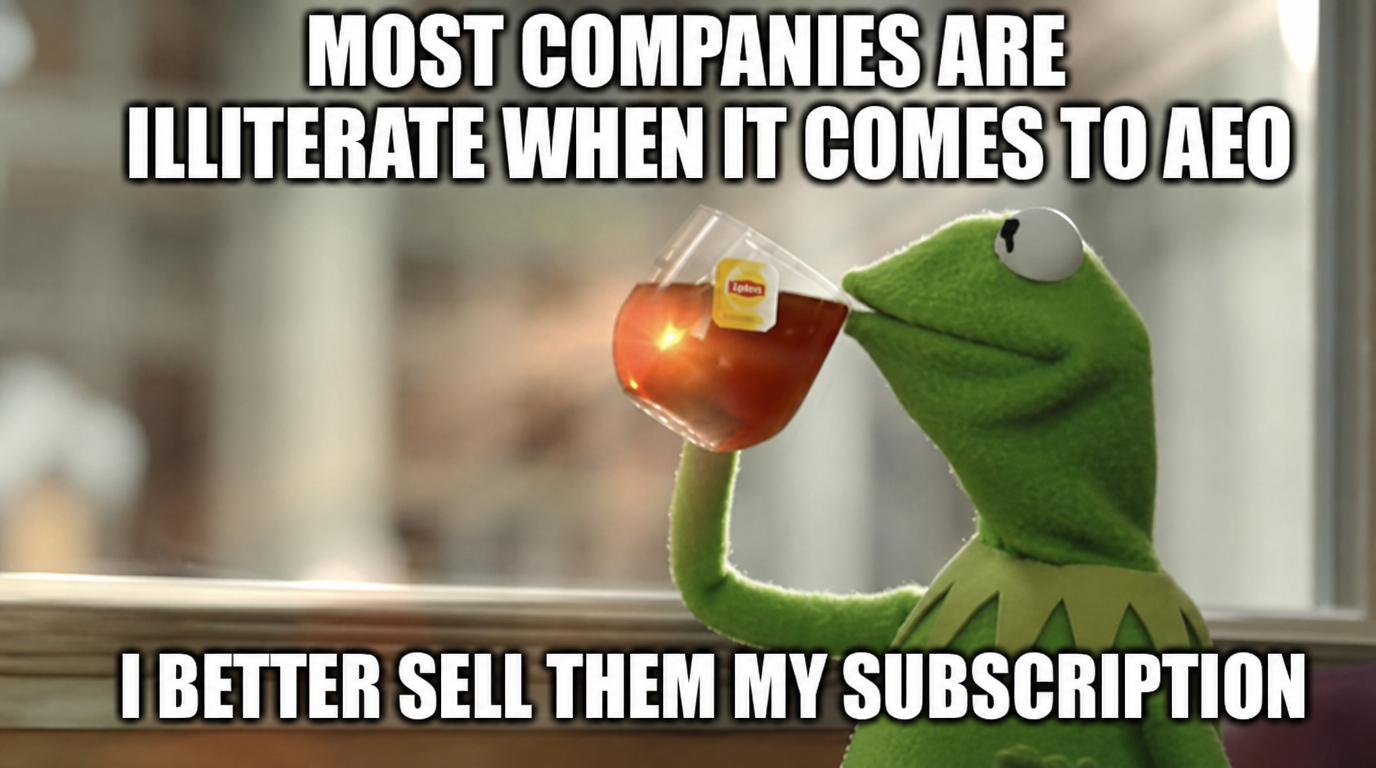
I have stood at a great many doors, and I can tell you: the loudest people outside a door are rarely the ones who know how to open it.
Lately the street outside yours has become very loud. Perhaps you've heard the ads. They arrive in your feed, your inbox, your podcast breaks, and they all say the same thing in the same breathless voice:
Your competitors are already ranking in ChatGPT — and you're not.
Every day you wait, you fall further behind. AI search is eating your business.
SEOSearch Engine Optimization (SEO): Search engine optimisation is the work of making a website rank highly in a list of search results — for twenty-five years, the main way a business got found online. Read the full entry in the glossary.Search Engine Optimization (SEO)Search engine optimisation is the work of making a website rank highly in a list of search results — for twenty-five years, the main way a business got found online.Read full entry is dead. If you're not doing AEOAnswer Engine Optimization (AEO): Answer Engine Optimization (AEO) is the practice of structuring your content so an AI or search engine can lift a clear, direct answer from it and show it to the person asking. Read the full entry in the glossary.Answer Engine Optimization (AEO)Answer Engine Optimization (AEO) is the practice of structuring your content so an AI or search engine can lift a clear, direct answer from it and show it to the person asking.Read full entry, you're already invisible.
Notice what these sentences have in common. None of them tells you anything about your website. None of them could — the people writing them have never seen it. What they know is something older and simpler: a frightened person buys faster than a calm one. So the product is not visibility. The product is fear, and fear has excellent margins.
There is a name for this trade, and I'll use it throughout: the Panic Industry.
The ritual they sell
Once the fear has done its work, the Panic Industry sells you a ritual. It goes roughly like this.
You must generate keywords — constantly, in bulk, forever. You must insert those keywords into your articles, your videos, your product pages, your captions. Then you must write prompts, thousands of them, and put those prompts to every AI model on the market to see what each one says. Then you must analyze the answers. Then you must cross-reference the answers against the keywords. Then a dashboard renders it all in forty charts, a report arrives, and next month the ritual begins again.
For this you pay a retainer. The going rate runs from a few hundred dollars a month to $10,000 and beyond, depending on how thoroughly you've been frightened.
Here is the mechanism worth understanding, because it explains everything else: the Panic Industry sells activity, not results. Activity is billable every month. Results would have to be promised, and promises can be checked. So the deliverable is motion — keyword matrices, prompt inventories, cross-analysis grids — an impressive amount of churning that never has to arrive anywhere. The busier the dashboard, the safer the retainer.
And I'll let you in on something I see from where I stand. When an AI system reads your website — and that is the entire game, a machine reading your pages — it never sees any of this. Not the keyword matrix, not the ten thousand prompts, not the dashboard. None of that noise crosses the sill. The only thing that ever crosses is the page itself: what it says, how clearly it says it, and whether it can be read at all.
Why the ritual is empty
So how does an AI answer engineAnswer Engine: A tool that responds to a question with a direct answer instead of a list of links to click — like ChatGPT, Perplexity, or the AI summaries now sitting at the top of Google. Read the full entry in the glossary.Answer EngineA tool that responds to a question with a direct answer instead of a list of links to click — like ChatGPT, Perplexity, or the AI summaries now sitting at the top of Google.Read full entry actually decide what to cite? Plainly, and without a single dashboard:
When someone asks ChatGPT or Perplexity a question, the system runs a search under the hood, finds pages that might answer it, reads them, and builds its reply from the ones it can actually use. What makes a page usable is unglamorous: it answers the question directlyAnswer-Shaped Content: Writing that leads with the answer to a real question instead of arriving at it — the single change that most often decides whether a machine can quote you. Read the full entry in the glossary.Answer-Shaped ContentWriting that leads with the answer to a real question instead of arriving at it — the single change that most often decides whether a machine can quote you.Read full entry, it's clearly structured, it states facts a machine can lift and verify, and it's plain about who's speaking and why they'd know.
Notice what's missing from that list. Keyword densityKeyword Density: The proportion of a page made up of a repeated search term — an old SEO measure that stopped working long ago, and now reads as spam to the machines it was meant to impress. Read the full entry in the glossary.Keyword DensityThe proportion of a page made up of a repeated search term — an old SEO measure that stopped working long ago, and now reads as spam to the machines it was meant to impress.Read full entry is not a signal. It was barely one for Google a decade ago, and to a language model — a machine built precisely to understand meaning rather than count words — it is nothing. Worse than nothing: a page stuffed with repeated phrases reads as spam to the exact machines you're trying to impress. The ritual doesn't just waste your money. It can actively harm the thing it claims to protect.
Now, a fair correction, because I'd rather be honest than tidy: the words you use do matter — once. If your customers ask about "emergency plumber near me" and your site only ever says "rapid-response hydraulic solutions," the machine may never connect you to the question. That's terminology: speak the way your customers ask. But aligning your vocabulary with reality is an afternoon of honest work, done once and revisited rarely. It is not a monthly subscription. It never was.
The kernel of truth they exploit
Every good con needs a true sentence at its center, and the Panic Industry has one: AI answers really are becoming how people find things, and an AI answer has very few slots. Where a search page offered ten blue linksTen Blue Links: Ten blue links is the old shape of a search result — a page of clickable headlines handing you a list of possibilities instead of an answer. Read the full entry in the glossary.Ten Blue LinksTen blue links is the old shape of a search result — a page of clickable headlines handing you a list of possibilities instead of an answer.Read full entry, an answer engine cites two or three sources. Showing up early in a small room compounds. That part is real.
But look at what they do with it. A real timeline is turned into a manufactured emergency, and the emergency is used to sell you the wrong work. That's the deeper damage — not the money, though the money is bad enough. It's that a frightened person, doing keyword theater at $10,000 a month, feels busy and protected while their actual pages stay exactly as unreadable as before. Fear doesn't just cost you. It aims you at the wrong target.
The honest version of the sentence goes like this: this matters, today is early, and early is an advantage that belongs to the calm.
What actually works
Here is what earns a citationCitation: When an answer engine names the source of what it just told someone — a business, a site, a particular set of words — instead of leaving the answer unattributed. The AI-era version of being recommended by name. Read the full entry in the glossary.CitationWhen an answer engine names the source of what it just told someone — a business, a site, a particular set of words — instead of leaving the answer unattributed. The AI-era version of being recommended by name.Read full entry. Five things. No jargon, no retainer, nothing you can't start tomorrow, alone, for free.
1. Write answer-shaped content
Take a question your customers actually ask — the one you answer on the phone every week — and answer it plainly in the first sentences of a page. Not after three paragraphs of throat-clearing. First. A machine assembling an answer reaches for pages that already contain one.
2. Say who you are, what you do, and where — in plain text
Not tucked into an image, not implied by a logo, not scattered across a footer. One clear passage a machine can read: we are this, we do this, we're here, this is how to reach us. You'd be surprised how many websites never quite say it.
3. Make your headings mean something
A heading is a signpostHeading Structure: The hierarchy of titles and subtitles on a page — the signposts a machine follows to work out what the page covers and where each answer sits. Read the full entry in the glossary.Heading StructureThe hierarchy of titles and subtitles on a page — the signposts a machine follows to work out what the page covers and where each answer sits.Read full entry. "Our Services" followed by "What we charge to repair a boiler in Zürich" is a page a machine can navigate. Five headings that all say variations of "Welcome" is a corridor with no doors.
4. Choose facts over adjectives
"Family-run since 1994, 3,000 roofs repaired, offices in two cantons" can be lifted, cited, and verified. "Passionate about excellence" cannot. Machines cite what they can check; so, incidentally, do people.
5. Make sure the machines can get in at all
A site that loads slowly, hides its text behind scripts, or quietly blocks crawlers is invisible regardless of how good the content is. The most common problem I see isn't bad writing — it's a locked door nobody knew was locked.
That's the whole liturgy. You'll notice it amounts to something almost embarrassing in its simplicity: say true things, clearly, on pages a machine can read. The Panic Industry cannot sell you this, because you can do it yourself — which is precisely why their version had to become complicated.
And now, the part where you should distrust me
Let's not pretend. This essay is published by Limen, and Limen sells a website audit tool. A company that profits from AI visibility is telling you to ignore other companies that profit from AI visibility. If your eyebrow just went up — good. Keep it there. That instinct is worth more than most retainers.
So here is the difference, stated flatly so you can judge it. Limen doesn't feed the fear; the entire point of the thing is to end it. A scan reads your actual pages, tells you in plain language what's wrong, and you fix it. Then — and this is the part no retainer will ever say to you — you're done. There's no monthly ritual, no matrix, no anxiety renewal. The findings are finite. The work is finite. And once your content is genuinely citable, you may knock yourself out with a bazillion parameters across a thousand dashboards if that's how you enjoy an evening. The door won't care. It never did.
The view from the doorway
The Panic Industry needs you exactly where you are: outside, frightened, and paying monthly for the privilege. Its business model is your permanent state of almost.
But I've watched people cross this particular threshold for a while now, and the crossing is never dramatic. Nobody sprints through in a panic. They fix a heading. They answer a real question on a real page. They say who they are in words a machine can read. And then, without ceremony, they're on the other side — cited, found, visible — while the megaphones are still outside, shouting at the next frightened person about competitors who never sleep.
Your competitors, for what it's worth, sleep fine. Most of them haven't even found the door.
Take a breath. Fix the page. The crossing takes care of itself.