

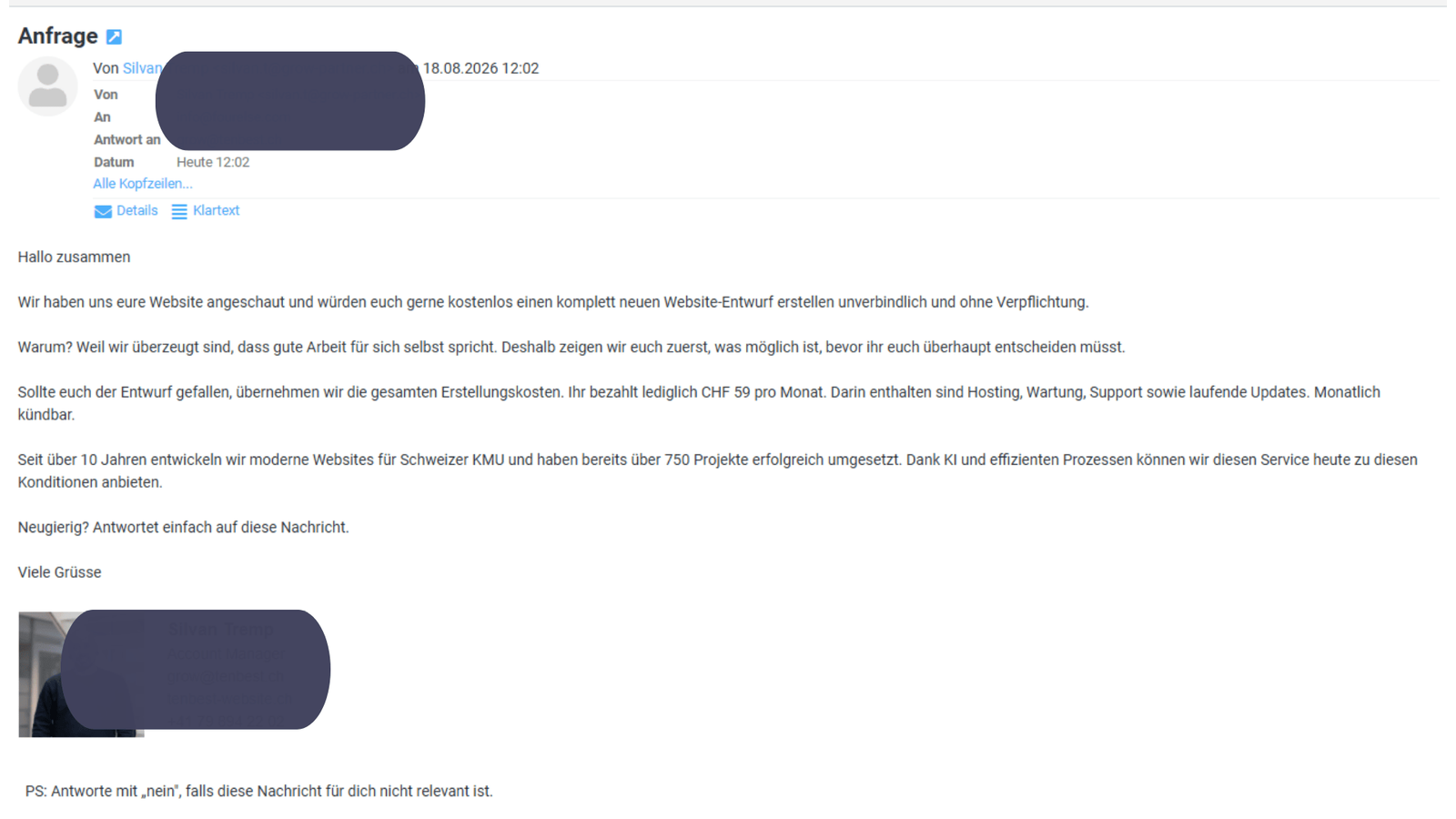
Recently a friendly email landed in my inbox: “We’ve taken a look at your website and would love to create a completely new website design for you, free of charge.”
How nice!
The timing could hardly have been better. We had just given our website 4else.events a thorough overhaul: we optimised the content, checked the structure and even analysed it with Limen, a specialised AEOAnswer Engine Optimization (AEO): Answer Engine Optimization (AEO) is the practice of structuring your content so an AI or search engine can lift a clear, direct answer from it and show it to the person asking. Read the full entry in the glossary.Answer Engine Optimization (AEO)Answer Engine Optimization (AEO) is the practice of structuring your content so an AI or search engine can lift a clear, direct answer from it and show it to the person asking.Read full entry/GEOGenerative Engine Optimization (GEO): Generative Engine Optimization (GEO) is the practice of shaping your content so AI tools like ChatGPT, Perplexity, and Google's AI answers cite, quote, or recommend your business when they respond. Read the full entry in the glossary.Generative Engine Optimization (GEO)Generative Engine Optimization (GEO) is the practice of shaping your content so AI tools like ChatGPT, Perplexity, and Google's AI answers cite, quote, or recommend your business when they respond.Read full entry tool, to see how well artificial intelligence can understand it and use it as a source.
And then along comes someone who has supposedly looked at our website and offers us web design.
Respect. You could fairly call that brazen. A web design agency is offering a web designer a new website.
It is rather like strolling into a bakery and saying:
“We’ve had a close look at your display and would love to show you how to bake bread.”
Looked at, or just found the domain?
Perhaps I should have felt flattered. After all, they wanted to create “a completely new website design, free of charge” for us. Only if we liked it would we pay, or rather just CHF 59 a month for hosting, maintenance, support and ongoing updates.
But something about the message bothered me: “We’ve taken a look at your website.” Really? Does he refer to what we offer? Has he recognised which audience we address? Did he notice a weakness there, and does he have a concrete idea of what could be improved? I am left in the dark, because none of that appears in this magnificent offer.
No reference to what we offer, no concrete content, no weakness identified and not a single observation about the website. Not even a name in the greeting, just:
“Hi everyone”
At least the recipient address was correct. Apparently no more personal attention than that had been planned for this enquiry.
AI has become astonishingly good at research
It can be done differently, though.
Recently I received a prospecting email for which a whole “team” had clearly been assigned to me. Presumably an exceptionally diligent AI team.
The email referred to my freshly published article about the Limen scan, mentioned fourelse, 4else.com and even passion.4my.horse. It analysed our business model, identified several platforms and derived supposed weaknesses in our customer acquisition from them.
That was impressive.
At first glance, at least.
Because while the AI had found a great deal of information, it had not placed all of it correctly. It explained to me, for example, that the growth of our course and event platforms depended heavily on existing customers and chance contacts. From that it derived concentration risks, a lack of scalability and marketing spend that is hard to calculate.
It sounded excellent.
Almost like a management consultancy.
Only I still did not know, afterwards, what this diagnosis was actually based on.
passion.4my.horse, too, was promptly interpreted as part of a possible acquisition strategy, even though the horse magazine is an entirely different project with an entirely different purpose.
So the AI had read thoroughly, combined eagerly and built an extremely professional story out of it. Unfortunately, it was not the story of fourelse.
A new kind of irrelevance
Bad advertising emails used to be easy to spot. They were full of typos, oddly translated, impersonal, and usually recognisable as a mass mailing by the first sentence.
Today they are polite, well structured and linguistically flawless. They pick up the company name, mention a product, quote a recent post and even put together a supposedly individual problem analysis.
AI has undoubtedly improved cold prospecting. But in doing so it has also created a new form of irrelevance: the highly professional message whose content does not survive a closer look.
It sounds personal without being personal.
It sounds researched without having really understood.
And it sounds competent, even though the offer itself shows that the sender has not really placed the recipient at all.
Personalised is not the same as personal
A company name in the subject line is not a personal approach.
Mentioning a blog article is not yet engaging with what it says.
And an automatically generated analysis is not yet an understanding of a company.
Real personalisation begins where a sender notices something that could not simply be transferred to a hundred other companies.
For example:
- a concrete gap in the offering,
- a recognisable technical error,
- a contradiction in the communication,
- an unused opportunity,
- or a point where your own offer could genuinely help.
Anyone who had really looked at my website would very quickly have seen that web design and digital solutions are part of my own line of work.
That would not make an offer for “a completely new website design” wrong in principle. Web designers can need outside support too. But then the email would have to contain a really good answer to the obvious question:
Why, of all people, should a web designer have you redesign her website?
That is exactly the answer that is missing.
The problem is not the AI
I have nothing against AI-assisted prospecting. On the contrary: used properly, AI can help to research companies, recognise connections and prepare an approach that is genuinely relevant.
Robin Bucciarelli, developer of the AEO/GEO tool Limen, has long seen the problem well beyond prospecting emails:
Unfortunately, a lot of people are being bombarded by these one-prompt AI slop agencies. They promise 100 or 1,000 automated articles a month, or one-prompt websites, and many people have no idea what horrendous damage they are doing to their company’s authenticity and trustworthinessE-E-A-T: Experience, Expertise, Authoritativeness and Trustworthiness — the shorthand for whether whoever wrote a page has any standing to say what they are saying. Read the full entry in the glossary.E-E-A-TExperience, Expertise, Authoritativeness and Trustworthiness — the shorthand for whether whoever wrote a page has any standing to say what they are saying.Read full entry.
AI cannot take responsibility off the sender’s hands. In the end, somebody has to check:
- Have we understood what this company does?
- Does our offer really fit?
- Is our problem analysis backed up, or merely plausibly worded?
- Does the email contain at least one concrete observation?
- Would we still send this message if we were sitting face to face with the recipient afterwards?
And perhaps the most important question:
Does our prospecting email make our own competence visible, or does it disprove our sales pitch?
Anyone who sells digital professionalism and sends out a flawed mass email has a problem.
So does anyone who offers strategic consulting and diagnoses the recipient with business risks they cannot back up.
And anyone who claims to have examined a website had better be able to say something that can actually be found on that website.
Think first, then automate
AI makes prospecting faster. In a few minutes it can gather information, write copy and prepare hundreds of supposedly personal messages.
But that is exactly where the danger lies. When an ill-fitting message costs only five minutes of work, the decision to send it comes easily. And when it sounds professional, the sender may not even notice any more how ill-fitting it is.
The recipient notices, though.
I admit it: I read almost all of these emails. Usually right to the end. But at some point I saw through the pattern. That someone engaged with our company only superficially is something I can live with. Still, an uneasy feeling lingers:
Nobody here was really interested in me. I was merely processed.
The irony is that the more strongly an email claims personal attention, the more obvious it becomes when that attention never happened.
An honest “We support Swiss SMEs with websites and would like to introduce what we offer”
might have been less spectacular, but more credible than “We’ve taken a look at your website.”
My request to all AI prospectors
Use AI. Let it do the research. Let it look for connections, develop ideas and improve your texts. But look at the result before you click “Send”.
- Actually visit the website.
- Check whether the problem you have identified exists.
- And ask yourselves whether your message sparks the recipient’s interest, or merely the suspicion that a machine with a great deal of self-confidence has cobbled something togetherHallucination: A hallucination is when an AI states something untrue with complete confidence — including wrong facts about your business, like the wrong hours, a price you don't charge, or a service you don't offer. Read the full entry in the glossary.HallucinationA hallucination is when an AI states something untrue with complete confidence — including wrong facts about your business, like the wrong hours, a price you don't charge, or a service you don't offer.Read full entry.
Because AI does not replace engaging with a potential customer. It merely makes it more visible whether that engagement took place.
For me, the time between opening an email and clicking the bin icon has become very short indeed.
This article was first published in German on 4else.events and appears here with the author’s permission.