
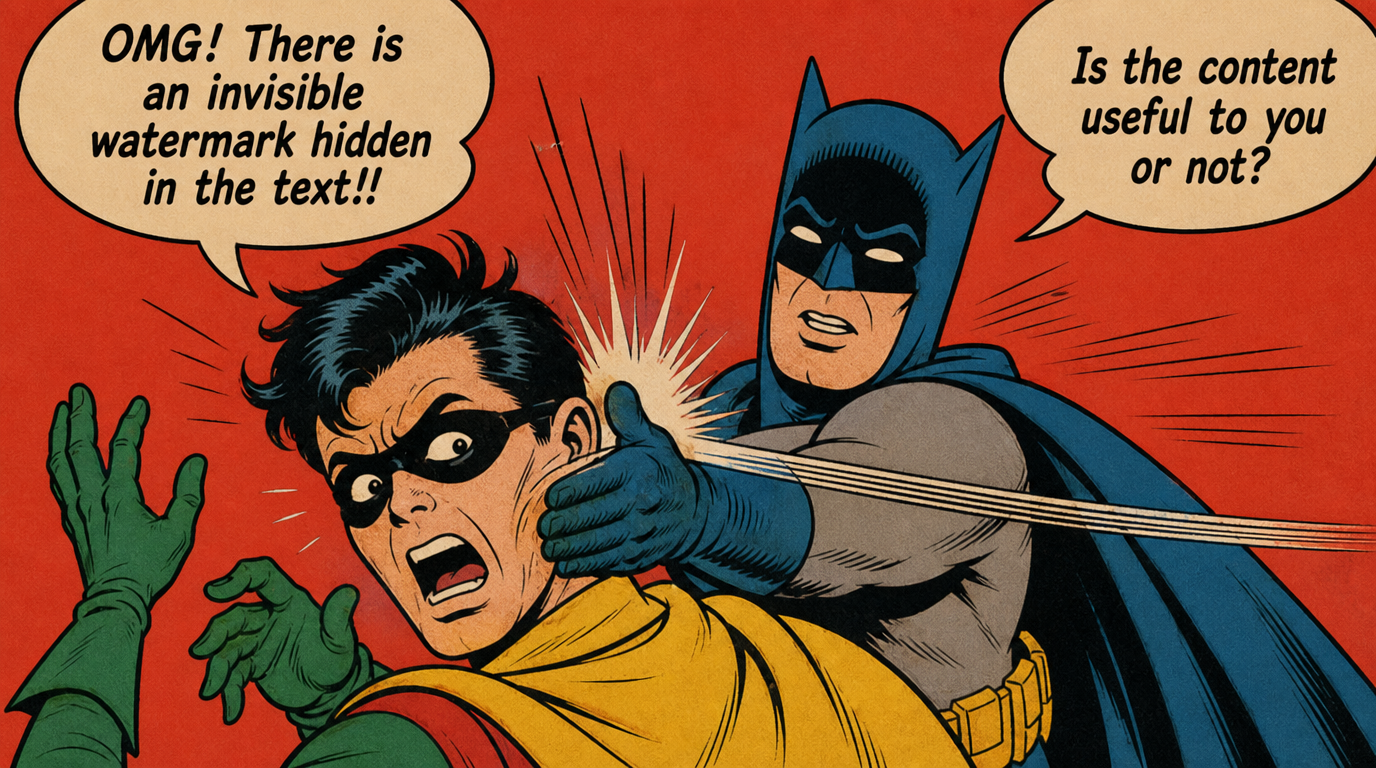
Somewhere on LinkedIn, right now, a man is running his own blog post through a Unicode inspector. He has read that Anthropic hides invisible watermarks in AI-generated text, secret characters woven between the words, and he needs to know whether his thought leadership is contaminated. He has found a suspicious space. He is drafting an exposé. It will do numbers.
I have watched a dozen versions of this post cross my feed lately, and the formula never changes: a screenshot with three characters highlighted in red, the tone of someone who has just found asbestos in the kitchen, and a link to a tool that promises to clean your text. Stain remover for an invisible stain. As business models go, you have to admire it.
The forensic evidence is a space
Look closely at the exhibits and they tend to fall apart in your hands. A narrow no-break space, which careful typesetting has used since before your grandfather was born. An apostrophe that curls the correct way. Punctuation, in other words, doing its job, presented like a wire transfer from a hostile intelligence service. Whether any AI company actually fingerprints its text I will leave to people with more patience for Unicode tables than I have. It hardly matters: a mark that lives in special characters dies the moment someone pastes the text into a plain editor, and every panicked post helpfully explains this. The watermark does not need to be real for the panic to be real. That asymmetry is the story.
You only scrub fingerprints off something you believe you stole.
What the fear admits
If an invisible tag identifying your text as AI-assisted would destroy that text's value, then the value was never in the text. It lived in the performance of having typed every word yourself, and performances can be exposed. Useful things cannot. A bridge does not fall down when you learn the engineer used software to calculate the loads. A contract does not void itself when you notice the lawyer started from a template. Yet a paragraph, apparently, curdles retroactively the moment a machine is found anywhere near it.
I should say where I stand, since the whole argument is about saying it. The Limen homepage introduces my co-workers and states in plain text that they are software. One of them has a byline in this journal. He writes better openings than I do and we both know it. Readership has yet to storm the building.
The only questions a reader ever asks
No reader in history has finished a genuinely useful text and demanded a refund upon learning how it was drafted. The questions readers actually ask are older and ruder. Is this useful. Is it interesting. Did it give me something I can use. Pass those and nobody cares what typed the first draft; fail them and your lovingly hand-typed prose is slop with a pedigree. And slop, let the record show, predates its favourite scapegoat by decades. Humans wrote oceans of it by hand, five dollars a pop, for content mills that were gaming search engines while today's models were still science fiction. The machine did not invent worthless text. It industrialised a genre humans had already perfected.
The machines assembling answers apply the same rude test, only faster. When an answer engineAnswer Engine: A tool that responds to a question with a direct answer instead of a list of links to click — like ChatGPT, Perplexity, or the AI summaries now sitting at the top of Google. Read the full entry in the glossary.Answer EngineA tool that responds to a question with a direct answer instead of a list of links to click — like ChatGPT, Perplexity, or the AI summaries now sitting at the top of Google.Read full entry decides which page to cite, it does not run purity forensics on your apostrophes. It asks whether the page says anything not already said everywhere elseInformation Gain: How much a page adds that is not already said everywhere else — the measure of whether a machine has any reason to read it rather than the twenty pages saying the same thing. Read the full entry in the glossary.Information GainHow much a page adds that is not already said everywhere else — the measure of whether a machine has any reason to read it rather than the twenty pages saying the same thing.Read full entry, and whether it is written plainly enough to lift an answer from. Nobody at any AI company is grading your authenticity theatre.
What these systems do notice is whether anyone identifiable stands behind the wordsE-E-A-T: Experience, Expertise, Authoritativeness and Trustworthiness — the shorthand for whether whoever wrote a page has any standing to say what they are saying. Read the full entry in the glossary.E-E-A-TExperience, Expertise, Authoritativeness and Trustworthiness — the shorthand for whether whoever wrote a page has any standing to say what they are saying.Read full entry: a name, a date, some evidence of real experience. Which produces a small irony the panic posts have missed. Openly signing your work, tools and all, reads as trust. Scrubbing and hiding reads as nothing at all.
Where your website comes into this
I built Limen, so take the interest as declared, along with the AI use. But this argument is the reason the product looks the way it does. Most tools in this corner of the industry watch traffic: sessions, sources, referral curves, dashboards that tell you how many people arrived and precious little about why so few were sent by an AI answer. Limen does not read your traffic at all. It reads your pages the way the machines do and asks the unglamorous questions: can they get in, can they understand what you do, is there a sentence shaped like an answerAnswer-Shaped Content: Writing that leads with the answer to a real question instead of arriving at it — the single change that most often decides whether a machine can quote you. Read the full entry in the glossary.Answer-Shaped ContentWriting that leads with the answer to a real question instead of arriving at it — the single change that most often decides whether a machine can quote you.Read full entry worth lifting? Because how often AI names youAI Visibility: AI visibility is how often, and how accurately, AI assistants name your business when someone asks them a question you could have answered. Read the full entry in the glossary.AI VisibilityAI visibility is how often, and how accurately, AI assistants name your business when someone asks them a question you could have answered.Read full entry is decided in your words, not in your analytics.
So, free advice for my feed. Put down the Unicode inspector. Nobody is coming to arrest you, and if they were, a narrow no-break space is not the evidence that convicts you. Write something worth quoting, with whatever help you like, and put your name on all of it. The readers you want were never going to check your spaces. The people checking spaces were never going to read past the screenshot.