
I spent a morning last week with a ninety minute livestream. Sabrina Ramonov, walking through her entire search playbook for 2026: fourteen numbered steps, real screenshots of her own results, nothing held back for a paid course. It is a generous talk and I recommend it.
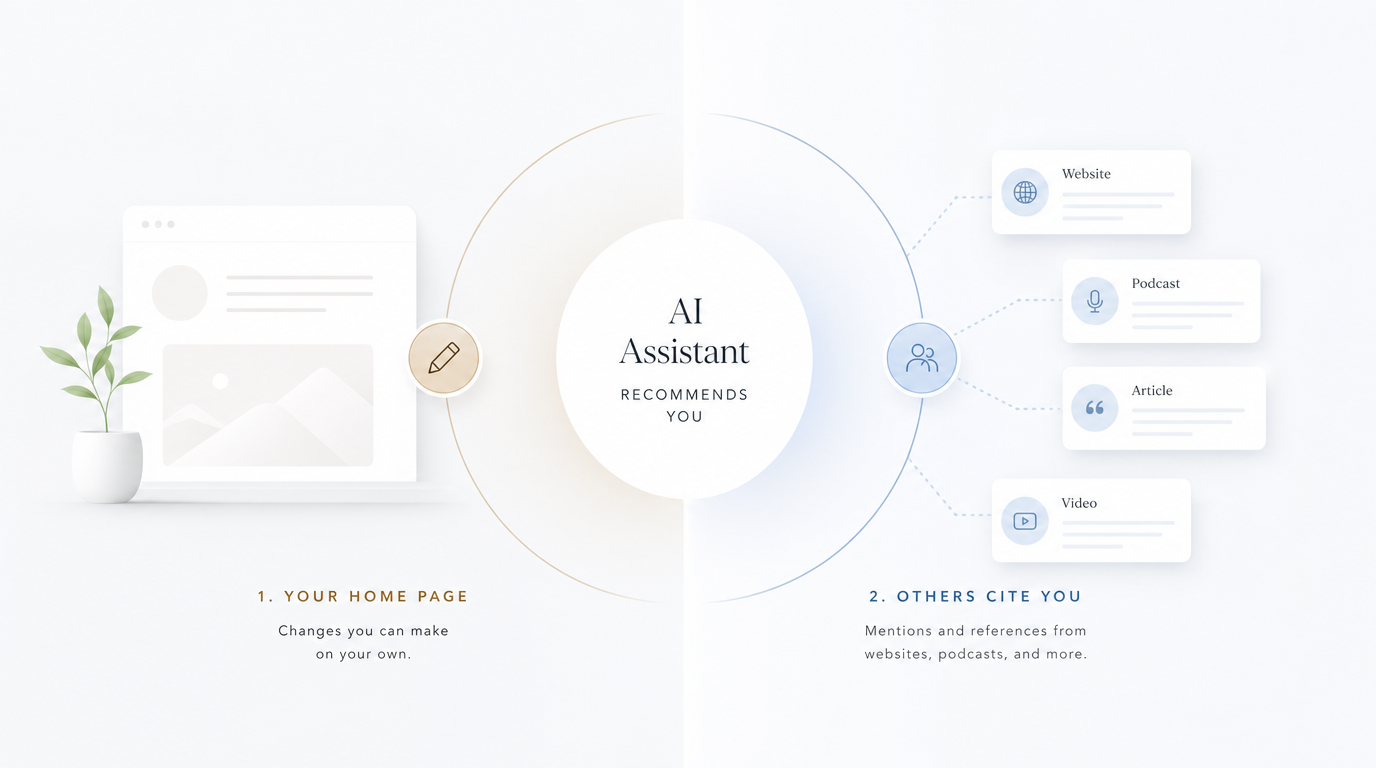
What stayed with me was not any single tactic. It was the shape of the list. Roughly half of those fourteen steps are things you do to your own website. The other half are things you try to make happen on somebody else's. Those two halves behave so differently that treating them as one job is where most of the confusion I hear actually starts.
What actually changed
In April, the software review site G2 surveyed 1,076 business software buyers. Fifty one percent of them said they now begin their research with an AI chatbot more often than with Google. A year earlier, the same question got twenty nine percent. That is the whole story of the last two years in one pair of numbers, and it is why every marketing conversation has suddenly filled up with talk of answer enginesAnswer Engine: A tool that responds to a question with a direct answer instead of a list of links to click — like ChatGPT, Perplexity, or the AI summaries now sitting at the top of Google. Read the full entry in the glossary.Answer EngineA tool that responds to a question with a direct answer instead of a list of links to click — like ChatGPT, Perplexity, or the AI summaries now sitting at the top of Google.Read full entry.
It is worth being precise about who was asked, because this figure gets repeated carelessly. These are people buying business software. They are not people looking for a dentist, a roofer or a wedding photographer. If you sell to consumers, your customers have not moved this far this fast. But nobody serious is arguing about the direction of travel.
A narrower door, with better people coming through it
The obvious fear is that this means less traffic. It does. The more interesting question is what the traffic that remains is worth, and there is one good measurement of it. In June last year Ahrefs, an established search company, looked at its own website and found that visitors arriving from AI assistants were half a percent of everyone who came, and twelve percent of everyone who signed up.
That is not magic. By the time an assistant sends somebody to you, it has already asked what they need, ruled out the things that do not fit, and told them you are the answer. The qualifying happened before the click. What arrives at your door is not a browser. It is somebody who has been told to come.
Two caveats, both of which Ahrefs raised themselves. This is one company reading its own analytics over one month, not a law of nature. And they point out that people arriving from AI assistants click through far less often than people arriving from an ordinary search, so the rates we are seeing now are probably about as good as they will ever be. Take the direction seriously and the decimal places lightly.
A narrower door, with better people walking through it. That is the trade on offer, and on balance it is a good one.
The split
Sort any 2026 playbook into two columns and it stops looking like fourteen unrelated chores. Everything on the list is either something you can change by yourself this afternoon, or something you have to persuade another human being to do.
Now the part that does not flatter my own product. In May, Muck Rack published the third edition of a study that reads more than twenty five million links citedCitation: When an answer engine names the source of what it just told someone — a business, a site, a particular set of words — instead of leaving the answer unattributed. The AI-era version of being recommended by name. Read the full entry in the glossary.CitationWhen an answer engine names the source of what it just told someone — a business, a site, a particular set of words — instead of leaving the answer unattributed. The AI-era version of being recommended by name.Read full entry by ChatGPT, Claude and Gemini across seventeen industries. Earned coverage, meaning pages on sites their subject does not own, accounts for eighty four percent of everything cited. Journalism on its own is twenty seven percent. Paid and advertorial placement is three tenths of one percent.
So the half you own is not half of the citations. It is closer to one in six.
Two things keep it worth doing anyway. The first is simple: it is the only half you can change without anyone's permission. Nobody has to say yes. The second is less obvious and matters more. The other half reads it. A journalist, a review site, somebody assembling a list of the best tools in your category: every one of them opens your website before they write a word about you. What they find there is what they repeat. If your homepage does not say openly what you do and who you do it for, they will either guess or move on to a company that made it easy.
And notice that three tenths of a percent. The shortcut, paying somebody to place you, barely registers in what the machines actually read.
The half you do not own
This is the older and slower discipline, and the numbers above say it is the bigger one. Get written about. Get listed. Turn up on other people's podcasts. It works; it compounds for years, which is precisely why so much of this industry is built on selling a way around it. I have written before about why a backlinkBacklink: A link on someone else's site pointing to yours — the one signal about your website you cannot create yourself. Read the full entry in the glossary.BacklinkA link on someone else's site pointing to yours — the one signal about your website you cannot create yourself.Read full entry is the one thing you cannot simply buyWhat a Backlink Is, and Why You Can't Buy One: You can write every word on your own website. The one thing you cannot do is get somebody else to point at it. Here is what that is worth, why it cannot be bought, and how it is actually earned. Read the full article in the journal., and the same logic runs through all of it.
Limen does none of this. We read your website. We cannot make somebody else write about you, and I would be uneasy about any tool that claimed it could. I am telling you this in the middle of an article on our own journal because you are going to find it out anyway, and it is better that you hear the shape of the problem from us.
Answer shaped, in simple words
The most useful idea in the whole livestream is not technical at all, so I want to put it in the simplest words I can. An assistant does not quote your page. It lifts a fragment out of it. Which means the unit of work is no longer the page. It is the paragraph. This is what people are reaching for when they say answer shaped contentAnswer-Shaped Content: Writing that leads with the answer to a real question instead of arriving at it — the single change that most often decides whether a machine can quote you. Read the full entry in the glossary.Answer-Shaped ContentWriting that leads with the answer to a real question instead of arriving at it — the single change that most often decides whether a machine can quote you.Read full entry, and it comes down to three habits.
Make the heading the question. Not "Pricing", but "How much does it cost". Not "Our Process", but "How long does a project take". Write the words a person would actually type.
Answer it immediately. First two sentences under the heading, before any throat clearing about your philosophy of pricing. The answer goes at the top or it does not get found.
Let every paragraph stand alone. Cover your whole page with your hand and leave one paragraph showing. Can that paragraph answer a question by itself, with nothing around it? If not, it will never be quoted, however good the page reads as a whole.
Nobody can tell whether any of it is working
This is the single most common thing I hear from people who arrive at Limen, and it is not what I expected when we started. It is almost never that they have done nothing. Plenty of them have done quite a lot. They have rewritten their homepage, added an FAQ, been told about their robots file and fixed it. What they cannot do is tell whether any of it landed.
The old world at least gave you a scoreboard. A position, a graph, something that held still long enough to be compared with last month. Ask an assistant the same question twice and you can get two different answers with two different companies named in them. There is no position to hold, and no amount of staring at it will make one appear.
So we built a number for the half that does hold still.
A Limen scan runs twenty checks against your homepage and reads what an AI assistant would read: whether it can get in, whether it can tell who you are, whether the answers are where it can reach them, and whether any of it looks worth believing.
It will not tell you what ChatGPT said about you this morning. Nothing honestly can, and I have written separately about why measuring AI visibility is the second job rather than the firstMeasure Later. Fix First.: Tracking your AI search performance is the second job. Here is the first one, why it comes first, and how long you should expect to wait before any of it shows. Read the full article in the journal.. What it will tell you is whether your site can be read, understood and quoted at all, which is the part you can do something about.
That is the whole argument. Two halves, one of them larger and slower and belonging to other people, one of them smaller and immediate and belonging entirely to you. Start where the door is unlocked.
If you want to see the state of your own half, seeing where you stand is free with a free account, and no card. It is the reading I would want before I spent a single hour on any of the rest of it.
Sources
AI SEO in 2026: Show Up in ChatGPT and AI Answers — Sabrina Ramonov
The Answer Economy: How AI Search Is Rewiring B2B Software Buying, April 2026 — G2
Does AI Search Traffic Convert Better Than Traditional Search?, June 2025 — Ahrefs